Monday, January 6, 2014

Quest for the Snowy Owl

(pic from birdsource.org)

Starting in mid November, numerous Snowy Owls have been spotted through out the United States, beyond their usual habitat in the Arctic, including as far south now as Jacksonville, Florida. This is not that unusual an occurrence and can be caused by increased numbers or lack of food.

What is unusual, though, is the numbers of owls reported with over 3400 spotted in the US thus far, with the spike beginning November 15 from 0 to over 2400 and then beyond. Pete Dunne stated that over 20 had been seen in NJ during this irruption up to the end of December.

Please see the ebird site for the range map through the end of
December of 2013:
http://ebird.org/ebird/map/snoowl1?bmo=1&emo=12&byr=2013&eyr=2014&gp=true

and explore the data yourself:

http://ebird.org/ebird/GuideMe?src=changeDate&speciesCodes=snoowl1&getLocations=northAmerica&reportType=species&monthRadio=on&bMonth=01&eMonth=12&bYear=2013&eYear=2014&continue.x=38&continue.y=4&continue=Continue

This is all very exciting and we had hoped to see one for ourselves last weekend. An owl had been spotted at the Cape May Point State Park on the dune, but was gone when we arrived.

The next day, we visited the 2 mile beach at the Cape May National Wildlife Refuge,


where another owl had been spending some time, but again with no luck, but the NWR was new for us and an excellent place to explore more.


Sunday, January 5, 2014

Excellent Nature Photography Site

I recently took some wonderful photography classes with 
photographer Valerie A. Hoffman 
(she is on facebook) and she sent me a link to an excellent ebook offered by this
nature photography site which I have found very helpful.  

I enjoy shooting birds, and this site offers 
and amazing images, such as this one: 


Here are some other helpful sites:


Saturday, November 23, 2013

A Brewing Kettle!

I was down at the beach on November 4th in the morning, sunny with 
strong winds out of the Northeast. 

I saw the kettle brewing. 

It was spectacular with over 50 birds, mostly Turkey Vultures, circling in a thermal 
over the dunes of the Point. 

Perhaps, they were gathering in preparation for migration.


It lasted for over 20 minutes, dynamically changing in shape and size with a variety of bird species. It grabbed the attention of many raptors in the area, who joined in, including several juvenile Red-tailed hawks with their dark shoulder bars, and Northern Harriers.


At the end of the gathering, the Turkey Vultures left, leaving only the hawks, soaring and circling right over my head on Ocean Avenue.


Friday, September 27, 2013

The Bittern that wasn't!

On the elevated nature paths on the yellow trail, left of the hawk observation deck at Cape May Point State Park, I spotted an American Bittern, so I thought, ruffled and quiet. It was located down left of the bridge in the canal that proceeds on to Lighthouse Pond East and looked a bit pensive. 


After getting some shots, I changed lenses, and aimed high to catch a juvenile Northern Harrier soaring by, with its dark head and "cinnamon-orange" body (Hawks in Flight by Dunne, Sibley, Sutton, p. 182). In each shot, it looks like its eyes are closed? 


I then trained my lens back to the Bittern and so glad I did. 
It had sprung to life and was hunting and then . . 


was attacking something in the water! 

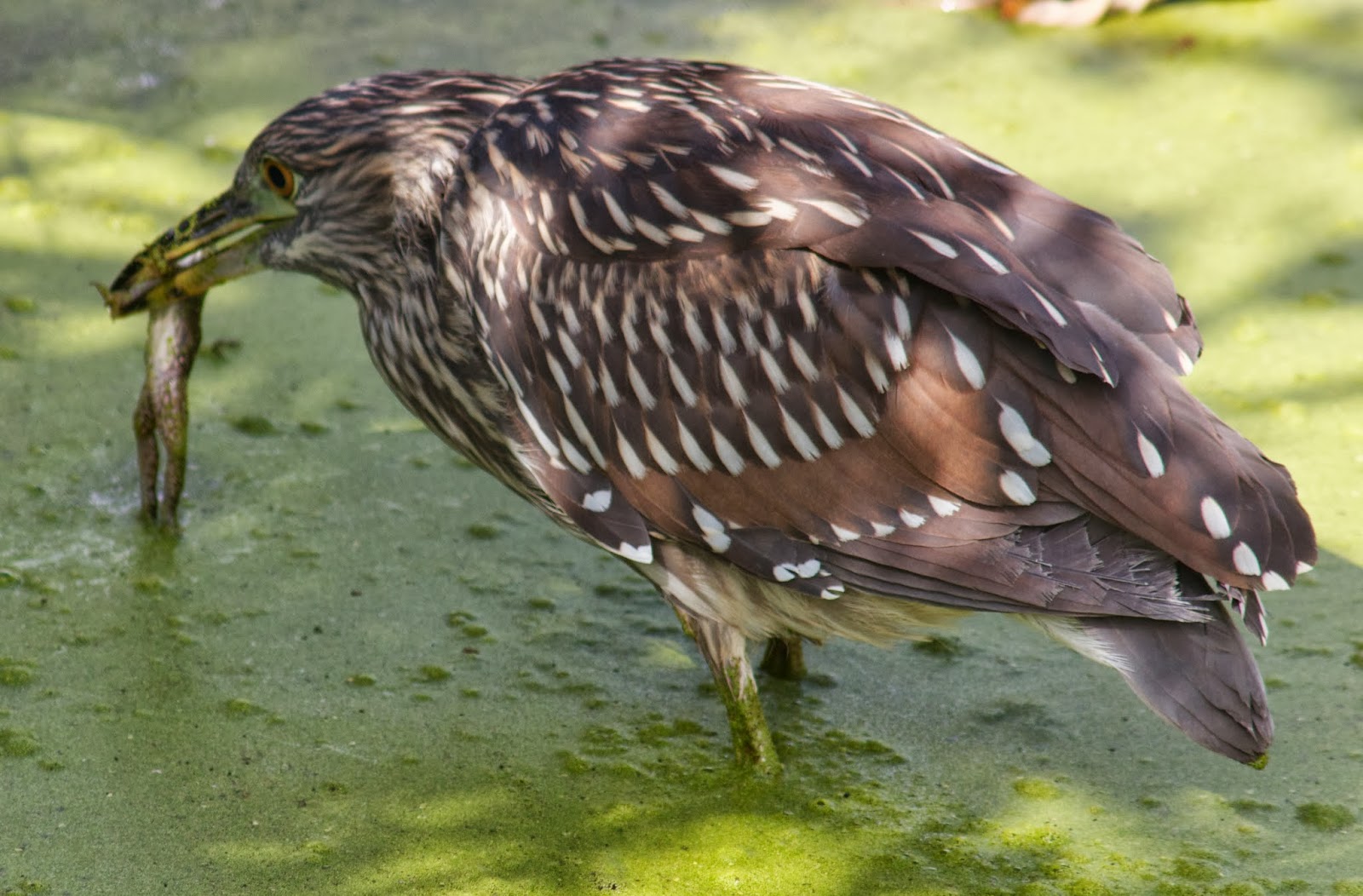
After dunking it many times, I could make out that it was a hapless frog.


It then gulped it down and here, a leg is the last bit to be seen.


I hurried home and downloaded these pictures. I checked my Sibley Guide to Birds to be certain of my ID that I felt confident about and I found that actually this was not an American Bittern at all!! 


The coloration is similar, but no bold stripes or long neck!

I flipped a few pages over and there it was. 

It was a Juvenile Black-crowned Night-Heron. 

Sibley's helpful progression was invaluable for the identification - the orange eye, the sharp yellowish bill, the large white spots on the wings, etc. 

I was astonished of how much this bird changes from a juvenile to an adult. 


Cape May Honey Farm Store

As a beekeeper myself, I always enjoy talking to other beekeepers, sharing information, and buying their products.

Here in Cape May, there is a wonderful store, Cape May Honey Farm, that opened earlier this year, which carries an amazing variety of honeys to purchase, beautiful candles, pottery, honey related gifts and products and more.


Andy runs the store and is very pleasant and helpful They are located on Sunset Boulevard on the right as you head to the beach and look for their sign:


Be sure to visit their wonderful site: http://www.capemayhoneyfarm.com/.

Their facebook page is a great way to follow them and find out about new gifts and offerings, as well.

Tuesday, September 3, 2013

Birding Books to Love

Over the weekend, my husband and I visited the Cape May Point Bird Observatory and had the honor and pleasure of meeting Pete Dunne, who was meeting with this year's new interns and preparing for the fall's migration season.  For over 37 years, Pete has led and shaped the course of CMBO and has written numerous excellent books on birding and such, including:


I have been struggling in identifying gulls, terns and other shore birds and also was wanting of more detailed information. We were searching the Center's large book collection for just the right book and Pete came over to welcome us and help us out. 

He recommended these two outstanding birding books:


This book provides several amazing colored pictures for each bird in various stages of maturation in its habitat and identifies birds using size, structure and color patterns. It also provides the detailed information I was looking for regarding migration and behavior and more.


The second book is The Sibley Guide to Birds and it is fantastic. 


I like how this book is organized, as it provides for each bird, a juvenile, an adult non-breeding and then an adult breeding colored drawing, including dates of when to expect this plumage coloration. 


It also includes descriptions, marking highlights, sizing, maps, call information, and has an excellent summary sheet for each Family.


Monday, August 19, 2013

The Gathering

On a recent visit in early August to the Point on an overcast, rainy, cool day, there were several groups of mixed shore birds congregating together, including Laughing Gulls, Royal Terns, Common Terns and other gulls. There were 4 different groups spread out along the shore ranging in size 
from 25 to 50 birds. 


The Royal Tern, like this one here, has a bright orange beak, a forked tail and a white head crowned with a black crest and black legs and feet.


Common Terns, such as this one, have a reddish and black tipped bill and black capped heads and bright orange legs and feet. They have started their migration southward, traveling as far as Peru and Argentina. 


This Royal Tern with its black tipped wings and white capped and black fringed head 
is ready for take off -