Showing posts with label Atlantic Ghost Crab. Show all posts

Thursday, June 27, 2013

Pondering about "Ghosties"


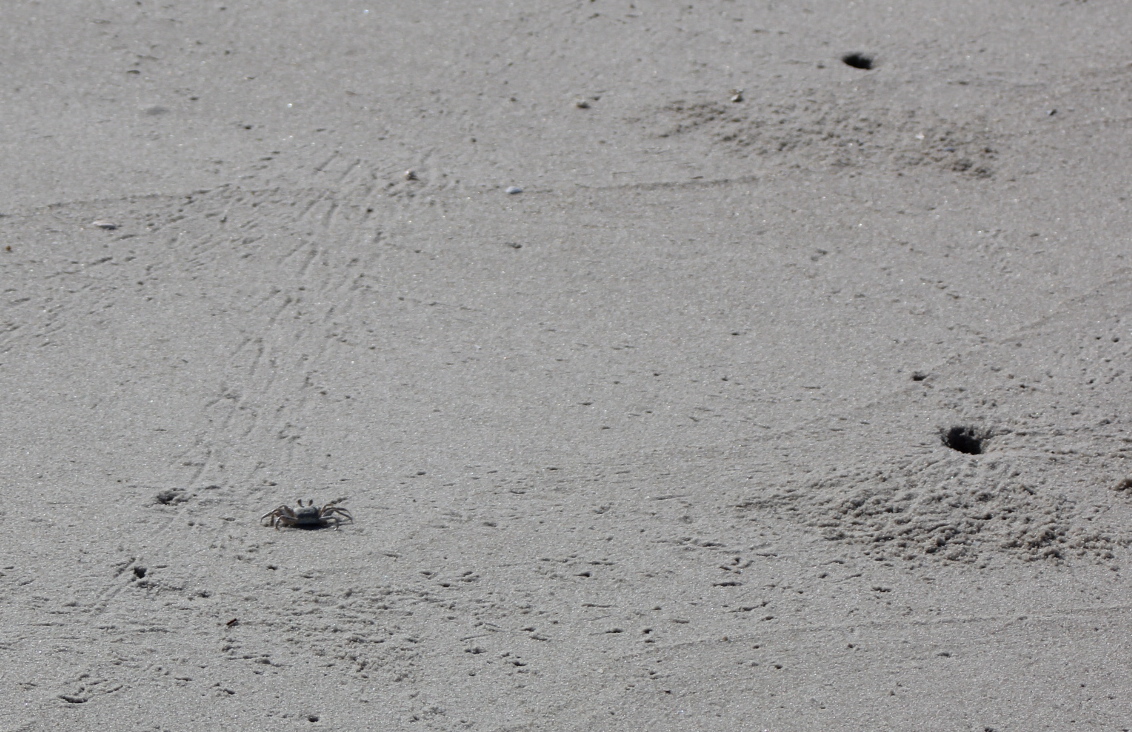
Over at the beach at the Cape May Point State Park, I continued to watch the Ghost crabs and wondered a number of things:

1. I noticed their tracks going well beyond the tide line and up to the dunes. Why are they wandering so far from their home?

2. Do they ever loose their way and can't find their home again? If not, do they simply build another one?

3. What are the different uses for their claws - I observed them being used: to defend themselves, to pat down the sand they excavated, to dig the hole and to excavate. Do they use them to attract a mate?

4. Why are they defending their hole - do they steal homes from one another?

5. What is inside their home? Do they have different rooms? Do they indeed have different entrances? If so, why?

6. How do the old and young interact? I saw the same sized crabs fighting but not big versus small. Are the smaller ones just younger or are they the females?

7. How long will they stay in the same home during the warmer months?

This site summarizes some interesting facts and provides recent research conducted about Ghost Crabs, if you are interested: http://animaldiversity.ummz.umich.edu/accounts/Ocypode_quadrata/.

Happy Ghost Crab Watching!

Tuesday, June 25, 2013

Ghost Crabs and Grackles


It is 80 degrees, hot and humid and the flies are biting today, but nonetheless, it is a beautiful day at the beach. The lifeguard stands and boats are out and umbrellas are up and children are frolicking in the high tide waves.


On the shore indentation, between Stites and Brainard, there is a large colony of Atlantic Ghost Crabs (Ocypode quadrata), numbering well over 200 or more. They are very active at this hour of 10:00 a.m. during high tide and just after the full moon, working on their homes, excavating and nibbling food at the tide's edge.


One very large crab brought out a lot of sand and then packed it down using its claws and running back and forth over its mound.


Their tracks in the sand are interesting to observe and it appears that they move from more than one hole and to surrounding holes. It is reported that they usually have one entrance but my observations find something different.


Although it is reported that the younger crabs build their burrows closer to the water, I found both young and older crabs had burrows equal distances to the water line. (http://animaldiversity.ummz.umich.edu/accounts/Ocypode_quadrata/)


I'm surprised to see, also, 2 Boat-tailed Grackles working along the shore line, picking up little shells and eating morsels they find and excitedly flying back and forth as the waves come crashing in.


Saturday, May 18, 2013

Crabs, Kites and Castles

Under cloudy, threatening skies, calm seas, and a light breeze out of the east, I walked the beach to investigate the changes that had taken place since my last visit.


The Stites walkway is radically changed, with most of the wooden planks removed and a wall built to help control the dunes.

There are little ugly crabs with tiny pinchers washed ashore, some dead, some alive.


After researching awhile, I find they are Libinia emarginata or otherwise known as the portly spider crab, common spider crab or nine-spined spider crab. They are omnivores, not especially aggressive and burrow in soft sediment, as stated on this great site: http://barnegatshellfish.org/crab01.htm. I also found a interesting blog along the way that helped me identify this crab and the site has some great photos of the area and beyond: http://urbanwildlandus.fatcow.com/NJ%20pages/New%20Jersey.htm

The Atlantic Ghost Crabs or Ocypode quadrata have adapted to the changes along the shore by building holes in high ridges created by the tides, with their second entrances up on top. In the background, the dunes have grown taller with the vegetation capturing the shifting sands of the Point.


and despite the weather, there is still time for kites


and castles