Showing posts with label birding. Show all posts

Monday, January 5, 2015

Birding Lists and Journals

Being a frequent visitor to Cape May, it is high time to start keeping track of all the birds I see. Where to start?  I bought a ABA Area Trip List at the Cape May Bird Observatory to first record all the birds I have ever seen. 


I would like a more permanent journal, but this is a start.  My list includes a rather meager number of only 130 species.

The 7.7 downloadable version for September 2014 of the ABA Birding Checklist can be found at this site and includes 987 species:  http://listing.aba.org/aba-checklist/. 

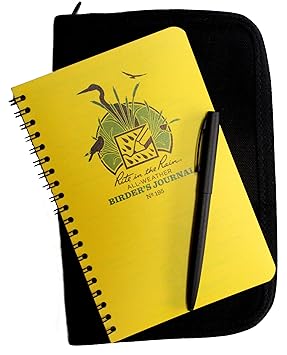
My goal is to increase my knowledge by participating in more birding classes in PA and NJ. I bought a Rite in the Rain All Weather Birder's Journal with a corresponding pen to use during these walks and classes and to keep track of what I see. 

I like what these blogs suggest for keeping a birding journal, such as:

a. Include the species name, habitat, weather, date, appearance, behavior, vocalizations, and flock size. 
b. Include a quick sketch. 
c. Note the color and size of the beak, the eyes, legs and feet.


The folks at 10,000 Birds Blog have an excellent post about why to keep birding lists: http://10000birds.com/birdlist.  I like how they have a digital running list for their life list and yearly list.

My goal is to at least double my number by the end of the year and keep a yearly list. I want to focus on shorebirds, gulls, warblers and sparrows. 


Wednesday, February 19, 2014

Birding Pals


Have you ever wished while traveling or perhaps, even in your own area, the 
knowledge of a local birder? 

Well, I found a site that provides exactly that and it is called "BirdingPal", which was started 14 years ago by a Canadian. For Cape May, for example, there are over 30 birders willing to go birding with you!

If you are a birder and willing to be a guide you can sign up, or if you need lodging, they provide choices. This looks like an excellent resource and I look forward to trying it sometime soon.

Click here to go to the site: http://www.birdingpal.org/


Monday, January 27, 2014

Coming in for a Landing!


I recently read an article in The Economist in the Science and Technology section that confirms my own personal observations. Flocks of birds land together in the same direction without any collisions and apparently they are aligned with the Earth's magnetic field as demonstrated in the pictures I found online above. Their preference is to land on the north-south axis regardless of weather, time of day or year or environment.

For the latest research on this subject, read on: http://www.economist.com/news/science-and-technology/21583591-how-flocking-birds-avoid-colliding-when-they-touch-down-birds-feather-land

For the original article in Frontiers in Zoology by H. Burda
see : http://www.frontiersinzoology.com/content/10/1/38

Sunday, January 5, 2014

Excellent Nature Photography Site

I recently took some wonderful photography classes with 
photographer Valerie A. Hoffman 
(she is on facebook) and she sent me a link to an excellent ebook offered by this
nature photography site which I have found very helpful.  

I enjoy shooting birds, and this site offers 
and amazing images, such as this one: 


Here are some other helpful sites:


Tuesday, September 3, 2013

Birding Books to Love

Over the weekend, my husband and I visited the Cape May Point Bird Observatory and had the honor and pleasure of meeting Pete Dunne, who was meeting with this year's new interns and preparing for the fall's migration season.  For over 37 years, Pete has led and shaped the course of CMBO and has written numerous excellent books on birding and such, including:


I have been struggling in identifying gulls, terns and other shore birds and also was wanting of more detailed information. We were searching the Center's large book collection for just the right book and Pete came over to welcome us and help us out. 

He recommended these two outstanding birding books:


This book provides several amazing colored pictures for each bird in various stages of maturation in its habitat and identifies birds using size, structure and color patterns. It also provides the detailed information I was looking for regarding migration and behavior and more.


The second book is The Sibley Guide to Birds and it is fantastic. 


I like how this book is organized, as it provides for each bird, a juvenile, an adult non-breeding and then an adult breeding colored drawing, including dates of when to expect this plumage coloration. 


It also includes descriptions, marking highlights, sizing, maps, call information, and has an excellent summary sheet for each Family.


Monday, August 19, 2013

The Gathering

On a recent visit in early August to the Point on an overcast, rainy, cool day, there were several groups of mixed shore birds congregating together, including Laughing Gulls, Royal Terns, Common Terns and other gulls. There were 4 different groups spread out along the shore ranging in size 
from 25 to 50 birds. 


The Royal Tern, like this one here, has a bright orange beak, a forked tail and a white head crowned with a black crest and black legs and feet.


Common Terns, such as this one, have a reddish and black tipped bill and black capped heads and bright orange legs and feet. They have started their migration southward, traveling as far as Peru and Argentina. 


This Royal Tern with its black tipped wings and white capped and black fringed head 
is ready for take off - 


Tuesday, July 2, 2013

Osprey: Alive and well in NJ

On May 20th, my daughter and I did Birding by Boat on the Osprey from Cape May and saw an amazing array of different bird species. In this entry, I will focus on the many osprey we saw.

As we headed out to the harbor, we passed this nest created with an variety of materials and
located on top of a marker:


At this nesting site, shown below, an osprey has a fish in its talons and below it is either its mate or offspring waiting to be fed. This nesting platform was certainly created and erected by the Conserve Wildlife Foundation of NJ as part of their efforts to help increase the osprey population. For more information, be sure to visit their site: http://www.conservewildlifenj.org/protecting/projects/osprey/

In 1974, the osprey population had plummeted from normally 500 to only 50 nests due to the effects of DDT. Because of the banning of DDT and then excellent conservation and management efforts of osprey, the number of nests rose to 486 in 2009. Another survey and census will be conducted this year.


As we motored around, we passed many osprey hunting. Unfortunately, it was an overcast day, so the lighting wasn't optimal.


Tuesday, June 25, 2013

Ghost Crabs and Grackles


It is 80 degrees, hot and humid and the flies are biting today, but nonetheless, it is a beautiful day at the beach. The lifeguard stands and boats are out and umbrellas are up and children are frolicking in the high tide waves.


On the shore indentation, between Stites and Brainard, there is a large colony of Atlantic Ghost Crabs (Ocypode quadrata), numbering well over 200 or more. They are very active at this hour of 10:00 a.m. during high tide and just after the full moon, working on their homes, excavating and nibbling food at the tide's edge.


One very large crab brought out a lot of sand and then packed it down using its claws and running back and forth over its mound.


Their tracks in the sand are interesting to observe and it appears that they move from more than one hole and to surrounding holes. It is reported that they usually have one entrance but my observations find something different.


Although it is reported that the younger crabs build their burrows closer to the water, I found both young and older crabs had burrows equal distances to the water line. (http://animaldiversity.ummz.umich.edu/accounts/Ocypode_quadrata/)


I'm surprised to see, also, 2 Boat-tailed Grackles working along the shore line, picking up little shells and eating morsels they find and excitedly flying back and forth as the waves come crashing in.