Showing posts with label Cape May Point State Park. Show all posts

Wednesday, August 16, 2017

Bees and Bunnies

Walking through Cape May Point State Park one afternoon, a young naive bunny was resting in the shade, at one of my favorite spots, under an old cedar tree.


 I got closer and closer and he didn't budge. 


 Having enough of me, he dashed off into the bushes. 


Just beyond, making homes in the hard packed sandy soil, the Rose Mallow bees were hard at work again. (See blog entry from August 17, 2016). 


This time I noticed, that the bees actually carry water to help loosen the soil, so they can dig holes. 


I also saw a large bearded insect positioned between the holes 


and I wondered if it was a predator, and sure enough, he zoomed and zagged trying to grab the bees as they worked, provisioning their nests.

Here is the result of Rose Mallow Bees' hard work -

thousands and thousands of beautiful rose mallows for as far as the eye can see.


Wednesday, August 17, 2016

Rose Mallow Season and Their Special Bee!

In Pavilion Park in Cape May Point, there is a simple dirt basketball court.


The ground is compacted, but loose and sandy enough for ground nesting bees to dig down and make homes for themselves.

And that is exactly what has happened! 

There are 50 - 100 holes, with bees flying, circling, 
digging and diving down.


Who are these bees? 

Why are they here?

After several calls, in an attempt to preserve their nesting site, I spoke with the naturalist from Cape May Point State Park, and he informed me that they are Rose Mallow Bees or Ptilothrix bombiformis.


They are solitary females, each creating their own nest, but in aggregate. The nests are not connected. Each bee provisions her own nest with pollen and nectar from just ONE type of plant, the Hibiscus, as they are specialist bees.

They are lazy bees and are cleptolectic, attempting to steal nesting sites of neighboring bees, which are typical of their Tribe Emphorini as mentioned in a published paper from Brazil: http://www.sea-entomologia.org/Publicaciones/PDF/BOLN45/281_288BSEA45Ptilothrix.pdf.

Here are 2 fighting over a hole:


They look like bumble bees, but they are not. They have a stout body, dense black hair, a yellow thorax and dark black abdomen with large folded wings, when not in flight. They also have prominent longer, hairier legs. Importantly, they do NOT sting!


They have a short life cycle, lasting about as long as the rose mallows' blooming period, from July to September. Swamp Rose Mallow (Hibiscus moscheutos), a native species to NJ, is a wetlands plant, with a 5 petaled colorful flower head and a spectacular sight to see in bloom.


I'm curious if this bee, also will feed from other Hibiscus varieties, such as Rose of Sharon (Hibiscus syriacus) and other Mallow varieties as listed here: (http://capemaywildlife.com/_templates/group_mallows.html) in the Cape May Point area or beyond?

For more information about these curious bees, visit the site: http://www.fs.fed.us/wildflowers/pollinators/pollinator-of-the-month/rosemallowbee.shtml

I hope the site will be protected, during their active season. I spoke with the Commissioner of Public Works at the Point, Robert Mullock, who knew about them, and who was happy to know I wasn't calling to ask to have them exterminated. I hope the area will be roped off and some signage will be installed to inform curious onlookers of this interesting bee.

Monday, January 6, 2014

Quest for the Snowy Owl

(pic from birdsource.org)

Starting in mid November, numerous Snowy Owls have been spotted through out the United States, beyond their usual habitat in the Arctic, including as far south now as Jacksonville, Florida. This is not that unusual an occurrence and can be caused by increased numbers or lack of food.

What is unusual, though, is the numbers of owls reported with over 3400 spotted in the US thus far, with the spike beginning November 15 from 0 to over 2400 and then beyond. Pete Dunne stated that over 20 had been seen in NJ during this irruption up to the end of December.

Please see the ebird site for the range map through the end of
December of 2013:
http://ebird.org/ebird/map/snoowl1?bmo=1&emo=12&byr=2013&eyr=2014&gp=true

and explore the data yourself:

http://ebird.org/ebird/GuideMe?src=changeDate&speciesCodes=snoowl1&getLocations=northAmerica&reportType=species&monthRadio=on&bMonth=01&eMonth=12&bYear=2013&eYear=2014&continue.x=38&continue.y=4&continue=Continue

This is all very exciting and we had hoped to see one for ourselves last weekend. An owl had been spotted at the Cape May Point State Park on the dune, but was gone when we arrived.

The next day, we visited the 2 mile beach at the Cape May National Wildlife Refuge,


where another owl had been spending some time, but again with no luck, but the NWR was new for us and an excellent place to explore more.


Friday, September 27, 2013

The Bittern that wasn't!

On the elevated nature paths on the yellow trail, left of the hawk observation deck at Cape May Point State Park, I spotted an American Bittern, so I thought, ruffled and quiet. It was located down left of the bridge in the canal that proceeds on to Lighthouse Pond East and looked a bit pensive. 


After getting some shots, I changed lenses, and aimed high to catch a juvenile Northern Harrier soaring by, with its dark head and "cinnamon-orange" body (Hawks in Flight by Dunne, Sibley, Sutton, p. 182). In each shot, it looks like its eyes are closed? 


I then trained my lens back to the Bittern and so glad I did. 
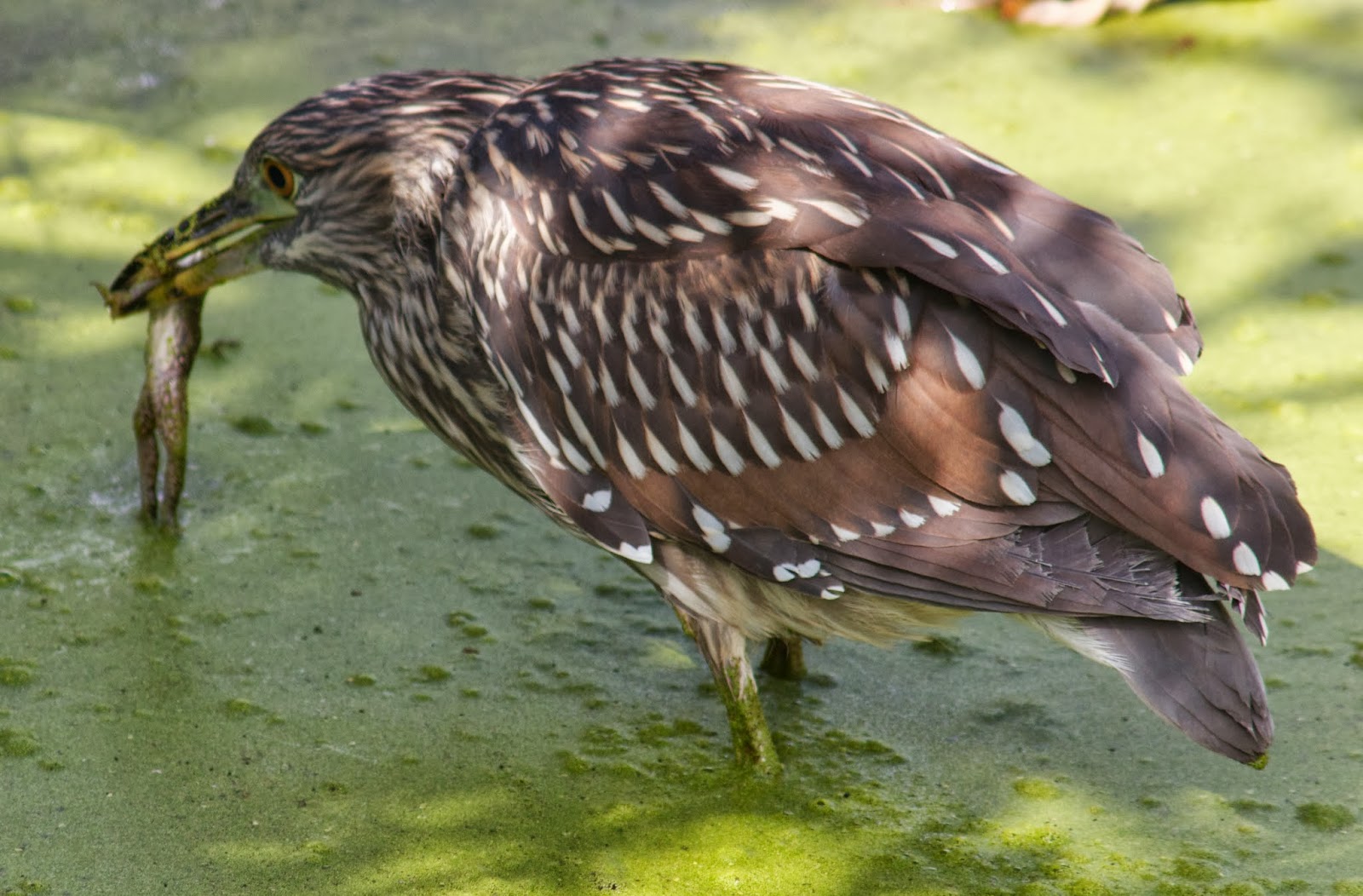
It had sprung to life and was hunting and then . . 


was attacking something in the water! 

After dunking it many times, I could make out that it was a hapless frog.


It then gulped it down and here, a leg is the last bit to be seen.


I hurried home and downloaded these pictures. I checked my Sibley Guide to Birds to be certain of my ID that I felt confident about and I found that actually this was not an American Bittern at all!! 


The coloration is similar, but no bold stripes or long neck!

I flipped a few pages over and there it was. 

It was a Juvenile Black-crowned Night-Heron. 

Sibley's helpful progression was invaluable for the identification - the orange eye, the sharp yellowish bill, the large white spots on the wings, etc. 

I was astonished of how much this bird changes from a juvenile to an adult.