Wednesday, February 19, 2014

Birding Pals


Have you ever wished while traveling or perhaps, even in your own area, the 
knowledge of a local birder? 

Well, I found a site that provides exactly that and it is called "BirdingPal", which was started 14 years ago by a Canadian. For Cape May, for example, there are over 30 birders willing to go birding with you!

If you are a birder and willing to be a guide you can sign up, or if you need lodging, they provide choices. This looks like an excellent resource and I look forward to trying it sometime soon.

Click here to go to the site: http://www.birdingpal.org/


Monday, January 27, 2014

Coming in for a Landing!


I recently read an article in The Economist in the Science and Technology section that confirms my own personal observations. Flocks of birds land together in the same direction without any collisions and apparently they are aligned with the Earth's magnetic field as demonstrated in the pictures I found online above. Their preference is to land on the north-south axis regardless of weather, time of day or year or environment.

For the latest research on this subject, read on: http://www.economist.com/news/science-and-technology/21583591-how-flocking-birds-avoid-colliding-when-they-touch-down-birds-feather-land

For the original article in Frontiers in Zoology by H. Burda
see : http://www.frontiersinzoology.com/content/10/1/38

Saturday, January 25, 2014

The Quest for the Snowy Owl Continues

After checking various blogs and calling several NWRs, we drove 50 minutes from Cape May to Forsythe NWR last weekend, January 18th, as a Snowy Owl had been sited that morning on the 8-mile Wildlife Drive, right at the first curve. There had been even one the day before spotted on the roof of the headquarters there. This is where most of the owls have been spotted and
I hoped we would be lucky.

It was our first visit to Forsythe and it was amazing with an expansive sky view, rich feeding and nesting areas and about 1,500 acres of fresh/brackish water marsh habitat created by a dike system that can be manipulated depending on the seasons, not to mention 5,000 acres of woodlands and 46,000 acres total.


I shot anything that was white, just in case . .


After we drove the first 5 miles or so, my heart started to sink, but then our attention was drawn to the 1000's of snow geese taking off and their undulating flight patterns . . .


for them to then just settle down again a few meters away . . .


This Peregrine Falcon got the most of attention at the time we drove through, with many stopping to take shots. A Snowy Owl had been spotted in the same location just a day before.


And at the end of the drive was a pair of Common Pintail . . 


The closest I'm going to get to a Snowy Owl this year is this lovely print I found at the West End Garage in West Cape May. 


Perhaps, I will have better luck next year. According to Clay and Pat Sutton's Birds and Birding at Cape May, Snowy Owls can be seen in the area annually. (page 150-151)

During the quest, I learned more about how to access more current information through Twitter and sites listed on the right column of my blog under Useful Birding Links, which I will continue to add to. Project SNOWstorm is especially worth a peak, as transmitters were attached to several owls to track their movements and the findings are exciting.

Monday, January 6, 2014

Quest for the Snowy Owl

(pic from birdsource.org)

Starting in mid November, numerous Snowy Owls have been spotted through out the United States, beyond their usual habitat in the Arctic, including as far south now as Jacksonville, Florida. This is not that unusual an occurrence and can be caused by increased numbers or lack of food.

What is unusual, though, is the numbers of owls reported with over 3400 spotted in the US thus far, with the spike beginning November 15 from 0 to over 2400 and then beyond. Pete Dunne stated that over 20 had been seen in NJ during this irruption up to the end of December.

Please see the ebird site for the range map through the end of
December of 2013:
http://ebird.org/ebird/map/snoowl1?bmo=1&emo=12&byr=2013&eyr=2014&gp=true

and explore the data yourself:

http://ebird.org/ebird/GuideMe?src=changeDate&speciesCodes=snoowl1&getLocations=northAmerica&reportType=species&monthRadio=on&bMonth=01&eMonth=12&bYear=2013&eYear=2014&continue.x=38&continue.y=4&continue=Continue

This is all very exciting and we had hoped to see one for ourselves last weekend. An owl had been spotted at the Cape May Point State Park on the dune, but was gone when we arrived.

The next day, we visited the 2 mile beach at the Cape May National Wildlife Refuge,


where another owl had been spending some time, but again with no luck, but the NWR was new for us and an excellent place to explore more.


Sunday, January 5, 2014

Excellent Nature Photography Site

I recently took some wonderful photography classes with 
photographer Valerie A. Hoffman 
(she is on facebook) and she sent me a link to an excellent ebook offered by this
nature photography site which I have found very helpful.  

I enjoy shooting birds, and this site offers 
and amazing images, such as this one: 


Here are some other helpful sites:


Saturday, November 23, 2013

A Brewing Kettle!

I was down at the beach on November 4th in the morning, sunny with 
strong winds out of the Northeast. 

I saw the kettle brewing. 

It was spectacular with over 50 birds, mostly Turkey Vultures, circling in a thermal 
over the dunes of the Point. 

Perhaps, they were gathering in preparation for migration.


It lasted for over 20 minutes, dynamically changing in shape and size with a variety of bird species. It grabbed the attention of many raptors in the area, who joined in, including several juvenile Red-tailed hawks with their dark shoulder bars, and Northern Harriers.


At the end of the gathering, the Turkey Vultures left, leaving only the hawks, soaring and circling right over my head on Ocean Avenue.


Friday, September 27, 2013

The Bittern that wasn't!

On the elevated nature paths on the yellow trail, left of the hawk observation deck at Cape May Point State Park, I spotted an American Bittern, so I thought, ruffled and quiet. It was located down left of the bridge in the canal that proceeds on to Lighthouse Pond East and looked a bit pensive. 


After getting some shots, I changed lenses, and aimed high to catch a juvenile Northern Harrier soaring by, with its dark head and "cinnamon-orange" body (Hawks in Flight by Dunne, Sibley, Sutton, p. 182). In each shot, it looks like its eyes are closed? 


I then trained my lens back to the Bittern and so glad I did. 
It had sprung to life and was hunting and then . . 


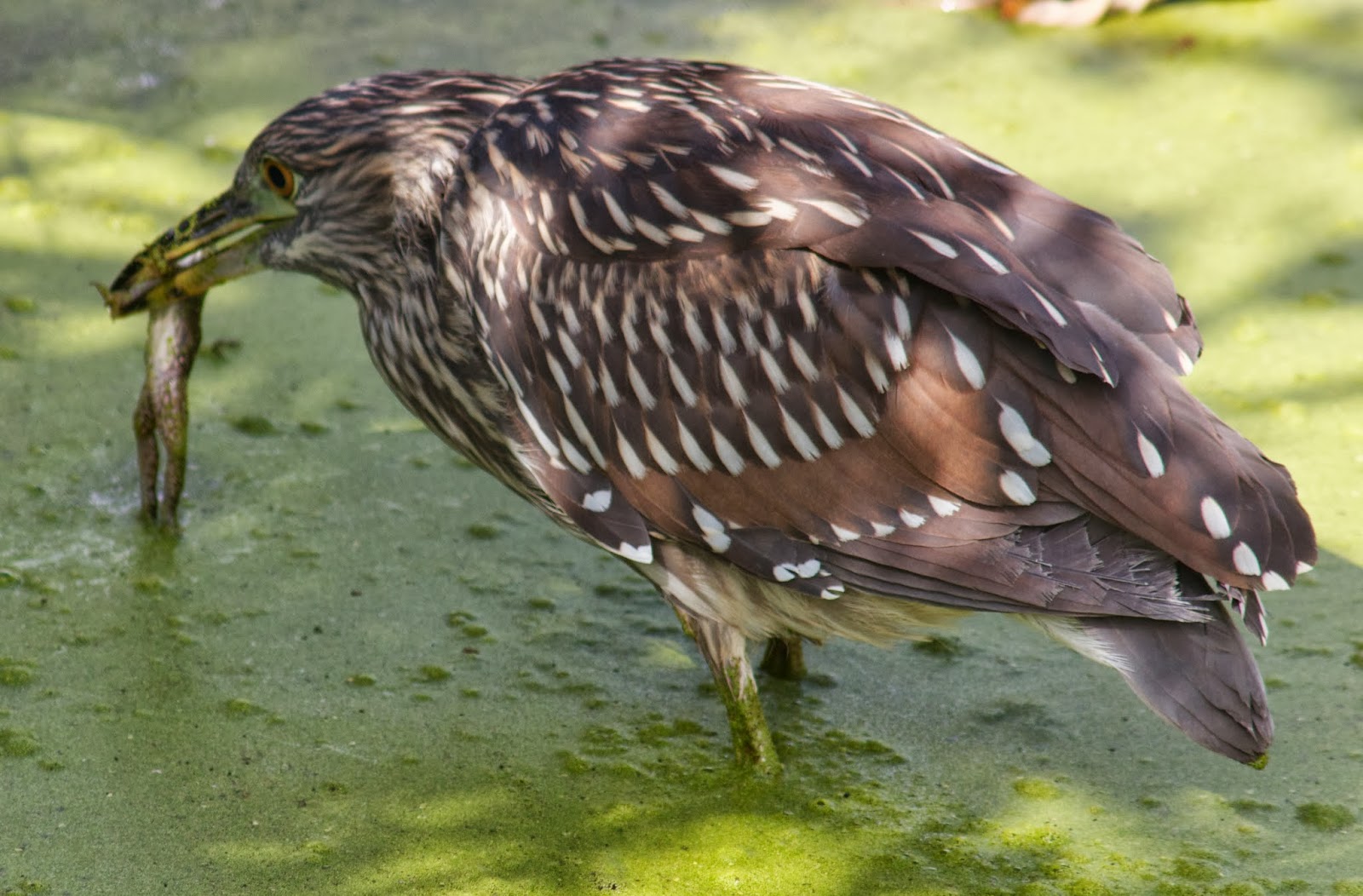
was attacking something in the water! 

After dunking it many times, I could make out that it was a hapless frog.


It then gulped it down and here, a leg is the last bit to be seen.


I hurried home and downloaded these pictures. I checked my Sibley Guide to Birds to be certain of my ID that I felt confident about and I found that actually this was not an American Bittern at all!! 


The coloration is similar, but no bold stripes or long neck!

I flipped a few pages over and there it was. 

It was a Juvenile Black-crowned Night-Heron. 

Sibley's helpful progression was invaluable for the identification - the orange eye, the sharp yellowish bill, the large white spots on the wings, etc. 

I was astonished of how much this bird changes from a juvenile to an adult.